
Most vehicle owners know their paint needs some kind of protection. The confusing part is deciding what kind.
For years, wax was the standard choice. It added shine, helped water bead, and gave paint a temporary layer of protection. Today, ceramic coatings are often presented as the better, longer-lasting option.
Both can make a vehicle look better and help protect the paint, but they are not the same product and they are not meant for the same type of owner.
The best choice comes down to how long you want the protection to last, how much maintenance you are willing to do, and what you expect the product to actually protect against.
What Does Car Wax Do?
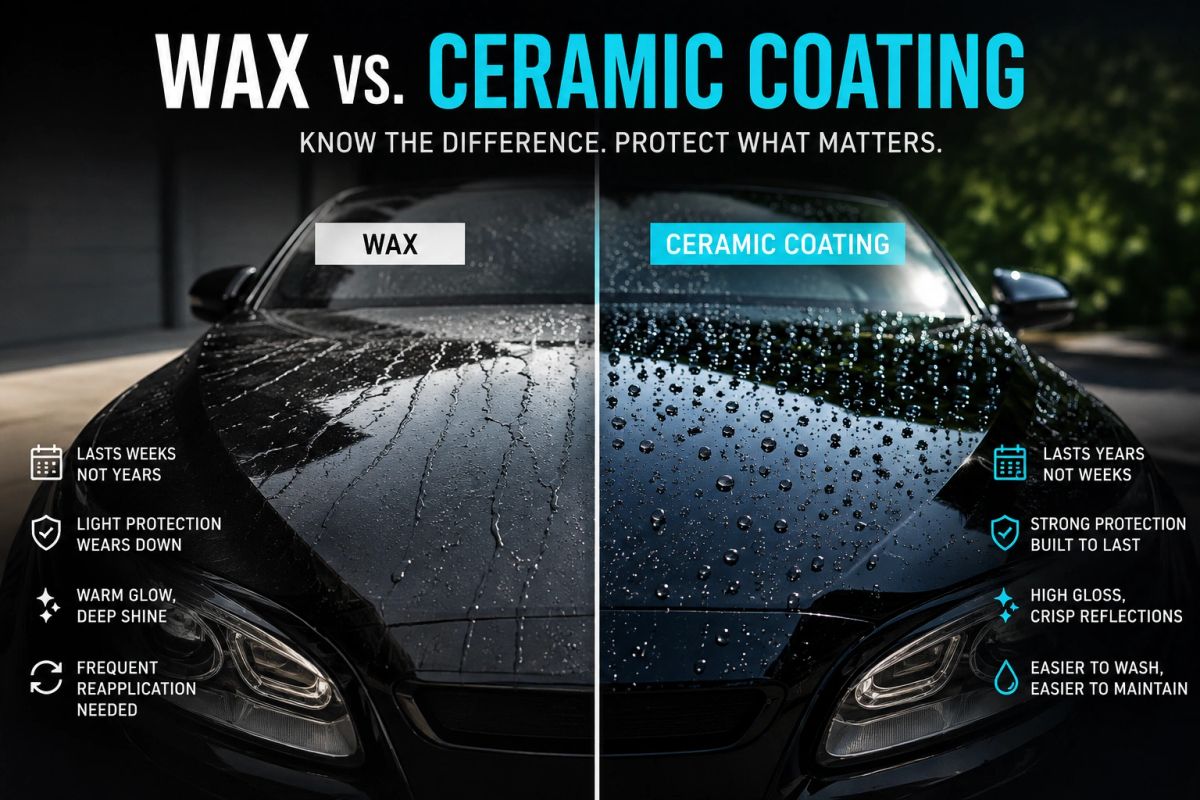
Car wax creates a temporary protective layer on top of the vehicle’s clear coat.
Traditional waxes may contain natural carnauba, synthetic ingredients, or a blend of both. Once applied and buffed, the wax leaves the surface smoother, glossier, and more water-resistant.
Wax can provide:
- A warm, deep shine
- Improved water beading
- Light resistance to dirt and environmental contamination
- A smoother-feeling finish
- Short-term protection from sun and weather exposure
One reason wax has remained popular is that it gives immediate results. A vehicle can look noticeably deeper and glossier after a single application.
It is also relatively affordable and accessible for DIY enthusiasts. With proper preparation, most people can apply wax at home without specialized equipment.
The drawback is durability.
Wax slowly breaks down from heat, rain, washing, chemicals, humidity, and daily exposure. Charleston’s summer heat, strong sunlight, heavy pollen, and frequent rain can shorten its lifespan even further.
Depending on the product, how the vehicle is stored, and how often it is driven, wax may last anywhere from a few weeks to a few months.
That means the protection must be reapplied several times throughout the year to maintain consistent performance.
What Is a Ceramic Coating?
A ceramic coating is a liquid protectant that bonds to the vehicle’s clear coat as it cures.
Instead of providing a short-term layer that quickly wears away, a coating is designed to create a more durable and chemically resistant surface.
Ceramic coatings can provide:
- Strong water-repelling behavior
- Easier maintenance washing
- Increased gloss and paint clarity
- Better resistance to chemicals and environmental contamination
- Longer-lasting protection than traditional wax
- Protection that may last several years with proper care
The biggest difference is how the product interacts with the paint.
Wax sits on top of the surface and gradually wears away. A ceramic coating bonds much more strongly to the clear coat, allowing it to remain in place longer.
That does not mean a coating becomes part of the paint forever. It will still wear down over time. However, it is designed to withstand far more washing, weather exposure, and chemical contact than wax.
How Long Does Each One Last?
Durability is one of the clearest differences between wax and ceramic coating.
Wax typically lasts weeks or months. Ceramic coatings are commonly designed to last years.
That does not mean every coating lasts the same amount of time. Durability depends on several factors:
- The coating product
- The quality of the installation
- How the vehicle is stored
- How often it is driven
- The local climate
- The washing process
- Whether maintenance products are used
- How quickly contamination is removed
A garaged weekend vehicle may retain protection much longer than a daily driver parked outside.
A properly maintained coating may continue performing for years, while a neglected coating can lose water behavior and effectiveness much sooner.
No protection is completely maintenance-free.
Which One Provides Better Protection?
Ceramic coatings generally provide stronger protection than wax against common environmental exposure.
A coating can help resist:
- Bird droppings
- Bug residue
- Tree sap
- Road film
- Pollen
- Chemical stains
- UV exposure
- Mineral deposits
- Everyday weather
This does not mean those contaminants can safely sit on the vehicle indefinitely.
Bird droppings, bug remains, tree sap, and hard water can still cause damage when left on the paint for too long. The coating gives the paint an additional barrier and can make the contamination easier to remove, but it does not eliminate the need for proper care.
Wax offers similar types of protection, but at a lighter and shorter-lasting level.
What Ceramic Coating Does Not Do
One of the biggest problems with ceramic coating is the amount of unrealistic marketing surrounding it.
A ceramic coating does not make paint scratch-proof.
It will not prevent:
- Rock chips
- Deep scratches
- Door dings
- Shopping cart damage
- Swirl marks caused by improper washing
- Scratches from automatic car wash brushes
- Damage from dirty towels
- Paint damage caused by neglect
A coating can resist very light marring better than unprotected paint, but it is not armor.
If preventing rock chips and physical impact damage is the main goal, paint protection film is the more appropriate product.
Ceramic coating is best understood as a durable surface protectant that improves chemical resistance, gloss, water behavior, and ease of maintenance.
Which One Looks Better?
Both wax and ceramic coating can improve the appearance of paint.
Wax is often known for producing a warm, rich glow. It can look especially good on darker solid colors, older vehicles, and show cars.
Ceramic coatings usually produce a sharper, glassier appearance. Reflections may look clearer, and metallic flake can appear more noticeable.
However, the final appearance depends heavily on the condition of the paint before the protection is applied.
Neither wax nor ceramic coating removes scratches.
If the paint has swirl marks, oxidation, water spots, or other defects, those imperfections may still be visible after protection is applied.
In some cases, adding gloss can actually make existing defects easier to see.
That is why paint correction or polishing is often recommended before a ceramic coating. The goal is to improve the paint before locking in the finished appearance.
Which One Is Easier to Maintain?
Ceramic coatings usually make routine cleaning easier.
Because the surface becomes more water-repellent and contamination has a harder time bonding, dirt and grime may release with less effort during washing.
Drying can also be faster because water tends to bead and move off the surface more easily.
Wax provides similar benefits while it is fresh, but the performance fades more quickly.
As wax breaks down, the paint may become less slick, water behavior becomes weaker, and contamination begins sticking more easily.
A coating maintains those benefits longer, but only when the vehicle is washed correctly.
Improper washing can still create scratches, even on coated paint.
Why Does Ceramic Coating Cost More?
Ceramic coating usually carries a higher upfront cost because the service involves much more than applying the coating.
A professional installation may include:
- A thorough wash
- Bug and tar removal
- Iron decontamination
- Clay-bar treatment
- Paint inspection
- Machine polishing
- Panel preparation
- Controlled coating application
- Curing time
- Final inspection
The preparation is one of the most important parts of the service.
Applying a coating over contamination, polishing oils, water spots, or poorly prepared paint can affect bonding, appearance, and durability.
Much of what a customer pays for is the labor, preparation, experience, and controlled application process required to get the coating to perform correctly.
Who Should Choose Wax?
Wax may be a good option for someone who:
- Enjoys maintaining their own vehicle
- Likes applying protection regularly
- Wants a lower upfront cost
- Keeps the vehicle mostly garaged
- Is preparing for a show or special event
- Only needs short-term protection
- Does not plan to keep the vehicle for several years
Wax is not a bad or outdated product. It simply requires more frequent attention.
For some enthusiasts, applying wax is part of the enjoyment of owning and caring for the vehicle.
Who Should Choose Ceramic Coating?
Ceramic coating may be a better fit for someone who:
- Drives the vehicle daily
- Parks outside regularly
- Plans to keep the vehicle for several years
- Wants easier maintenance
- Wants longer-lasting protection
- Owns a dark-colored vehicle
- Deals with heavy pollen, rain, heat, and humidity
- Wants to reduce how often protection must be reapplied
A coating is especially useful for owners who want durable protection without applying wax every few months.
The Bottom Line
Wax and ceramic coating both improve gloss and help protect automotive paint, but they serve different purposes.
Wax offers affordable, temporary protection with a warm shine. It works well for owners who enjoy frequent hands-on maintenance and do not mind regular reapplication.
Ceramic coating provides longer-lasting protection, stronger chemical resistance, improved water behavior, and easier maintenance. It costs more upfront, but it reduces how often the protective layer must be replaced.
The right choice is not always the most expensive option.
It is the option that best matches how the vehicle is driven, stored, washed, and maintained.