
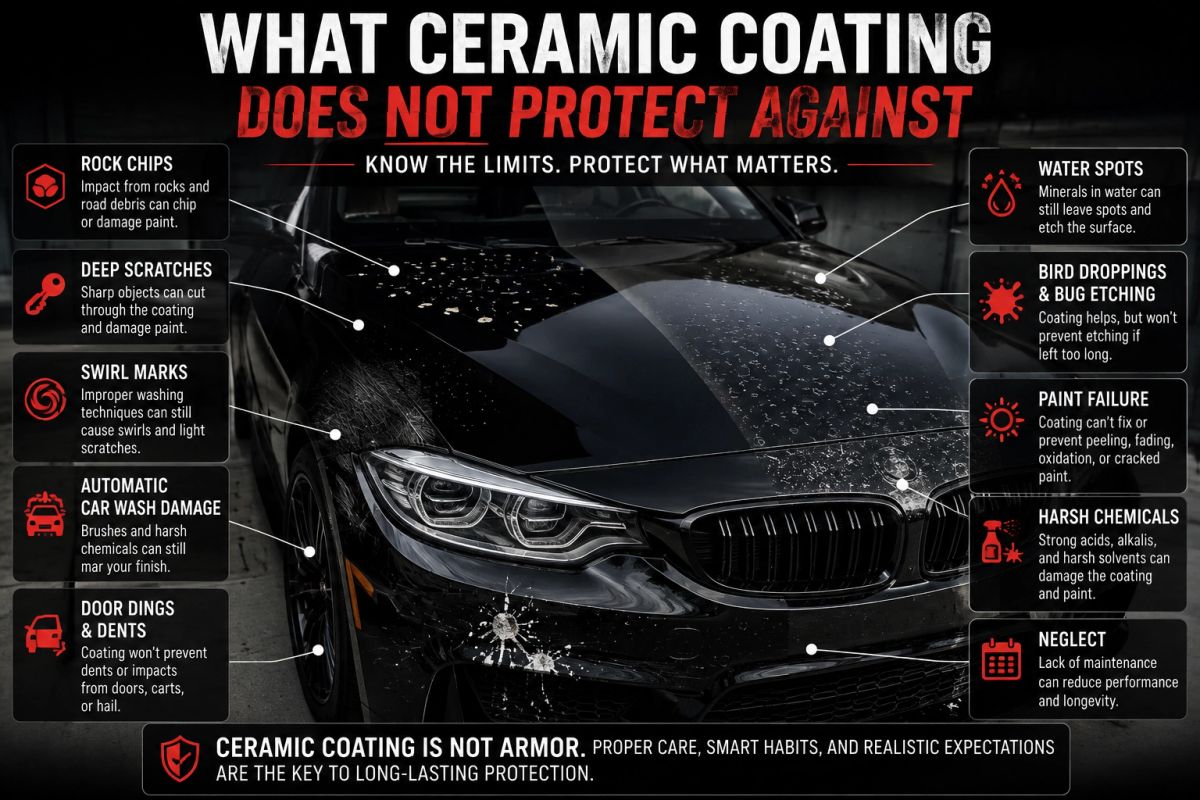
Ceramic coating offers excellent protection against environmental contamination, chemicals, UV exposure, and everyday grime.
But it is not armor.
A coating can help preserve your vehicle’s finish and make maintenance easier, but it cannot stop every form of damage. Understanding its limits is just as important as knowing its benefits.
Here is what ceramic coating does not protect your vehicle from.
Rock Chips
Ceramic coating will not stop rocks, gravel, or road debris from chipping your paint.
When a rock strikes the front bumper, hood, mirrors, or fenders at highway speed, the impact can break through the clear coat and paint. A ceramic coating is far too thin to absorb that kind of physical force.
For protection against rock chips, paint protection film is the better option.
Paint protection film, often called PPF, is a thicker flexible layer designed to absorb impacts. Ceramic coating and PPF can also be used together, with film protecting high-impact areas and coating making the vehicle easier to clean.
Deep Scratches
Ceramic coating does not prevent deep scratches.
Keys, tree branches, tools, shopping carts, belt buckles, and other hard objects can still cut through the coating and damage the clear coat underneath.
A coating may offer some resistance against extremely light marks, but it cannot stop damage caused by sharp objects or significant pressure.
Once the scratch reaches deeply into the clear coat or paint, polishing may not be enough to remove it.
Swirl Marks From Improper Washing
One of the biggest misconceptions is that a coated vehicle cannot develop swirl marks.
It absolutely can.
Swirl marks are usually caused by dragging dirt or contaminated materials across the paint. Common causes include:
- Automatic car wash brushes
- Dirty wash mitts
- Low-quality towels
- Dry wiping dusty paint
- Reusing wheel towels on the body
- Scrubbing instead of using proper chemicals
- Washing without enough lubrication
Ceramic coating does not stop these materials from scratching the surface.
A coated vehicle still needs to be washed safely. Clean microfiber towels, dedicated wash tools, proper soap, and gentle techniques remain essential.
Automatic Car Wash Damage
Ceramic coating does not make a soft-touch automatic car wash safe.
The brushes and cloth strips inside these washes contact hundreds of vehicles. Dirt, sand, brake dust, and other abrasive debris can remain trapped in the equipment.
That contamination can then be dragged across the next vehicle, creating scratches and swirl marks.
The coating may take some of the initial wear, but repeated automatic washes can damage both the coating and the paint underneath.
A reputable touchless wash is generally a safer emergency option, though a careful hand wash remains the best maintenance method.
Door Dings and Dents
Ceramic coating will not prevent dents caused by car doors, shopping carts, hail, or other impacts.
A coating protects the surface chemically. It does not strengthen the metal or prevent body panels from bending.
Paintless dent repair may be able to correct certain dents when the paint remains intact, but the coating itself provides no protection against the impact.
Water Spots
Ceramic coating can help reduce how strongly mineral deposits bond to the surface, but it cannot guarantee that water spots will never form.
When hard water dries on the paint, minerals are left behind. Heat and sunlight can bake those deposits onto the surface and may eventually cause etching.
The strong water beading associated with ceramic coatings can sometimes leave droplets sitting on the paint. If those droplets contain minerals and are allowed to dry, spotting can still occur.
The safest approach is to dry the vehicle properly and avoid washing in direct sunlight.
Bird Dropping and Bug Etching
Ceramic coating provides added resistance against bird droppings and bug residue, but it does not make them harmless.
These contaminants may contain acids and other materials that can damage the coating and paint when left in place, especially on a hot surface.
The coating gives you an extra layer of defense and often makes cleanup easier. It does not mean contamination can sit on the vehicle indefinitely.
Remove bird droppings, bugs, and tree sap as soon as reasonably possible.
Paint Failure
Ceramic coating cannot repair peeling clear coat, oxidation, cracking, fading, or other forms of paint failure.
If the clear coat is already failing, the coating has no stable surface to bond to. It may temporarily add some gloss, but it will not reverse the damage.
Severe paint failure usually requires refinishing or repainting.
Ceramic coating works best as a preventative measure on healthy paint, not as a repair for paint that has already failed.
Poor Paint Preparation
A coating will not hide scratches, water spots, oxidation, or swirl marks.
Because ceramic coating increases gloss and clarity, it can actually make paint defects more noticeable.
That is why the preparation process matters so much.
Before installing a coating, the paint may need:
- A thorough wash
- Chemical decontamination
- Clay treatment
- Water-spot removal
- Machine polishing
- Paint correction
- Surface preparation
The coating preserves the surface underneath it. If the paint looks poor before installation, the coating does not magically correct it.
Neglect
Ceramic coating is often described as low-maintenance, but that does not mean no maintenance.
A coated vehicle still needs regular washing. Road grime, minerals, pollen, oils, and contamination can build up on top of the coating and reduce its performance.
Over time, a neglected coating may appear to stop beading or feel less slick. In some cases, the coating is still present but clogged with contamination.
Regular maintenance helps preserve:
- Water behavior
- Gloss
- Slickness
- Chemical resistance
- Overall durability
The better the coating is cared for, the better it will perform.
What Ceramic Coating Is Designed to Do
Ceramic coating is best understood as a durable surface protectant.
It is designed to:
- Improve chemical resistance
- Reduce contamination bonding
- Increase gloss
- Make washing easier
- Improve water behavior
- Protect against environmental exposure
- Last longer than traditional waxes and sealants
These are meaningful benefits, especially for daily-driven vehicles exposed to Charleston’s heat, humidity, rain, pollen, insects, and strong sunlight.
The key is having realistic expectations.
The Bottom Line
Ceramic coating does not make a vehicle scratch-proof, chip-proof, dent-proof, or maintenance-free.
It cannot stop rock chips, deep scratches, door dings, automatic wash damage, or paint failure. It also cannot compensate for poor washing habits or neglected maintenance.
What it can do is provide a durable protective barrier that improves chemical resistance, reduces contamination bonding, enhances gloss, and makes routine care easier.
Ceramic coating works best when it is treated as a powerful layer of protection, not an invisible suit of armor.